December 8, 2025 — United States
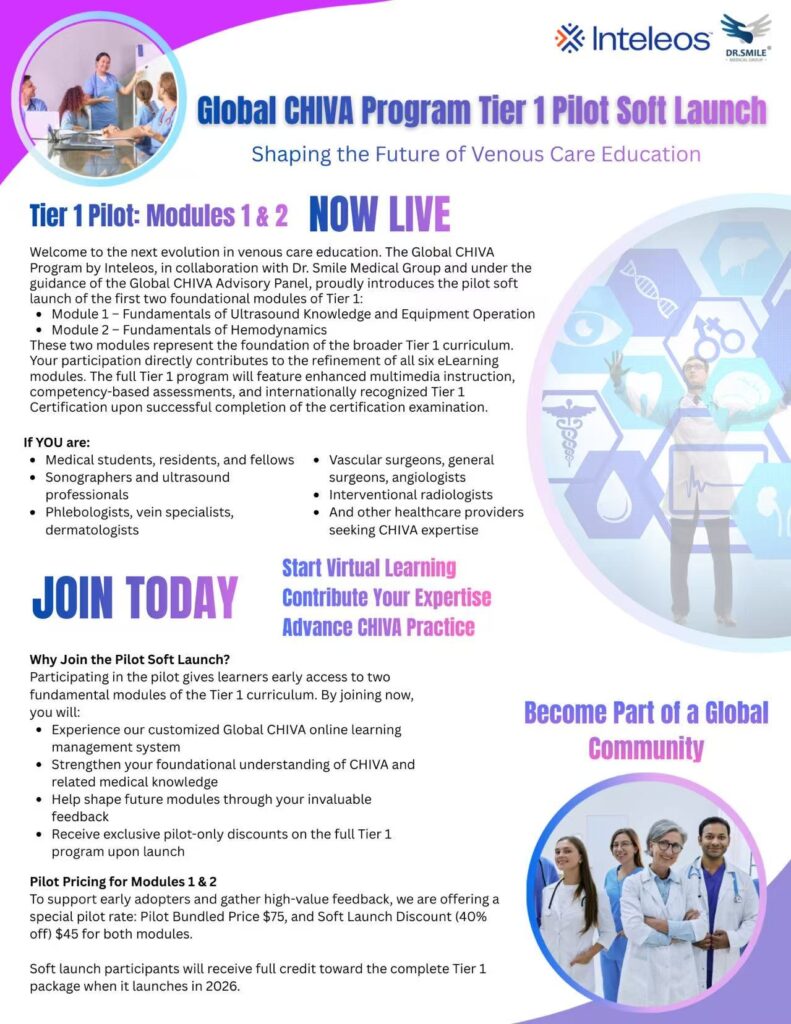
As interest in hemodynamic-guided approaches to venous disease continues to rise, one challenge has remained consistent across countries: the absence of a shared educational structure for CHIVA. This month, the Global CHIVA Program took a notable step toward addressing that gap, launching the pilot of its Tier 1 curriculum with two foundational modules focused on ultrasound and venous hemodynamics.
Unlike prior local or center-based training efforts, the new program aims to create a learning pathway that can be understood—and applied—across borders.
Why a Global Framework Has Become Necessary
Although CHIVA has been practiced for decades, especially in Europe and parts of Asia, its adoption has been uneven. The principles of flow redistribution and targeted, function-preserving intervention require careful interpretation of duplex findings. Yet, clinicians have historically lacked a common starting point: terminology differs between regions, scanning techniques vary, and treatment decisions often depend more on local tradition than shared reasoning.
The collaboration between Inteleos and Dr. Smile Medical Group, supported by an international advisory panel, is an attempt to bring coherence to this landscape. Their goal is not simply to teach CHIVA, but to define the minimum knowledge and reasoning framework clinicians everywhere should share.
What the Tier 1 Pilot Offers
The pilot begins with two modules that sit at the base of all CHIVA-related decision-making:
Ultrasound Fundamentals
A structured introduction to duplex techniques essential for mapping venous flow.
Rather than prescribing advanced protocols, the module focuses on establishing consistency—an essential step if clinicians are to compare findings across centers.
Principles of Venous Hemodynamics
This content outlines how different escape points, drainage pathways, and shunts contribute to chronic venous symptoms, and how targeted interventions can modify flow without compromising physiologic return.
Both modules reflect a central aim of the program: to create a shared conceptual platform before moving on to procedural planning or advanced interpretation.
The pilot phase will run with open feedback, allowing instructors and learners from different regions to highlight where concepts need refinement or where clinical variations may require clearer explanation.
Potential Impact Beyond Education
A standardized entry-level curriculum could reshape more than individual training. If widely adopted, it may:
- Align terminology and assessment across countries
- Improve the reproducibility of CHIVA-based interventions
- Enable more meaningful multicenter studies
- Provide a basis for long-term development of an international credential
For regions without experienced CHIVA trainers, a digital, modular program may also expand access to structured instruction.
In a field increasingly oriented toward precision, minimally invasive strategies, and preservation of venous function, the ability to compare practices across borders may influence future guidelines and research priorities.
Who the Pilot Is Designed For
The program is open to a broad group: vascular surgeons, phlebologists, interventional radiologists, ultrasound physicians and technologists, and trainees at various stages. Those who enroll during the pilot will automatically transition into the full Tier 1 curriculum as new modules become available through 2026.
Looking Ahead
The Tier 1 pilot introduces only part of the planned curriculum, but it marks the first coordinated attempt to construct an international educational structure around CHIVA. As the remaining modules progress through development, the initiative may lay the groundwork for a common language—one that allows clinicians in different regions to interpret venous hemodynamics with greater consistency and confidence.
For a technique that depends so heavily on understanding flow rather than simply anatomy, this shared foundation may prove essential as the field continues to evolve.
Registration
The Tier 1 pilot modules are available through the Global CHIVA Program learning platform:
👉 https://globalchiva.talentlms.com/plus