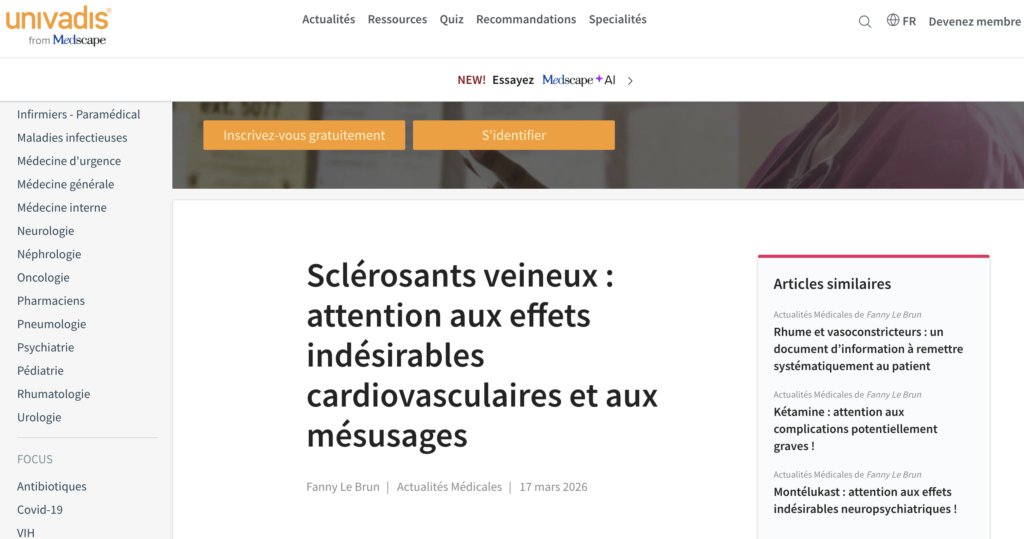
Recent pharmacovigilance updates from the French National Agency for the Safety of Medicines and Health Products (ANSM) have renewed attention to the safety profile of injectable venous sclerosing agents used in the treatment of varicose veins and chronic venous disease. Despite years of regulatory monitoring and risk-minimization measures, serious cardiovascular adverse events continue to be reported following sclerotherapy procedures. (VIDAL)

Venous sclerosing agents, including lauromacrogol 400 (marketed as Aetoxisclerol®) and sodium tetradecyl sulfate (Fibrovein®), are commonly used in liquid or foam form to obliterate incompetent superficial veins. Although generally considered effective and minimally invasive, these agents are associated with rare but potentially life-threatening complications. (VIDAL)
According to recent French pharmacovigilance data covering the period from July 2021 to June 2024, 56 adverse-event reports related to venous sclerosants were identified, including 35 events classified as “events of special interest.” Among these, 21 cases were considered serious, and one patient death was reported. Most cases involved lauromacrogol 400. (VIDAL)
Reported complications included:
- Venous thromboembolic events such as deep vein thrombosis and pulmonary embolism
- Cardiac rhythm disturbances
- Neurological manifestations, including migraine-like syndromes and reversible posterior encephalopathy syndrome (PRES)
- Visual disturbances such as transient blindness, scotoma, and photopsia
- Arterial embolic events and paradoxical embolism
- Severe allergic reactions, including anaphylaxis
- Tissue necrosis associated with inadvertent intra-arterial injection (VIDAL)
The ANSM emphasized that several serious adverse events occurred in patients who already had contraindications or significant thromboembolic risk factors. In addition, cases of inappropriate preparation or administration techniques were reported, including excessive concentration, improper dilution, and injection at a single site. (VIDAL)
Current contraindications highlighted by French authorities include:
- Previous thromboembolic disease
- Known thrombophilia or active cancer
- Prolonged immobilization
- Multiple thrombotic risk factors (e.g., obesity, smoking, hormonal therapy)
- Symptomatic patent foramen ovale (PFO)
- Significant communications between superficial and deep venous systems (VIDAL)
To improve procedural safety, the ANSM reiterated several recommendations for physicians performing sclerotherapy:
- Careful screening for contraindications and thromboembolic risk factors
- Strict adherence to recommended preparation and injection protocols
- Continuous patient monitoring during and immediately after injection
- Availability of emergency equipment, including a defibrillator and anaphylaxis management tools
- Comprehensive patient education regarding warning symptoms after treatment (VIDAL)
Patients are advised to seek urgent medical attention if symptoms such as chest pain, dyspnea, palpitations, neurological deficits, visual disturbances, or calf swelling occur after injection therapy. (VIDAL)
Importantly, the safety concerns surrounding venous sclerosants are not new. French regulatory authorities have maintained enhanced surveillance since 2008, and earlier literature had already documented severe medico-legal complications associated with inadvertent arterial injection, including cases requiring limb amputation. (VIDAL)
While sclerotherapy remains an established component of modern varicose vein management, the recent ANSM communication underscores the importance of rigorous patient selection, standardized injection techniques, and ongoing vigilance regarding cardiovascular and neurological complications. These updates may further influence future international discussions on procedural safety standards in phlebology and minimally invasive venous interventions. (VIDAL)
Original Source
This article was inspired by and adapted from reporting originally published on Univadis France / Medscape France and related French regulatory communications from the ANSM.
Original article link:
Univadis France Article