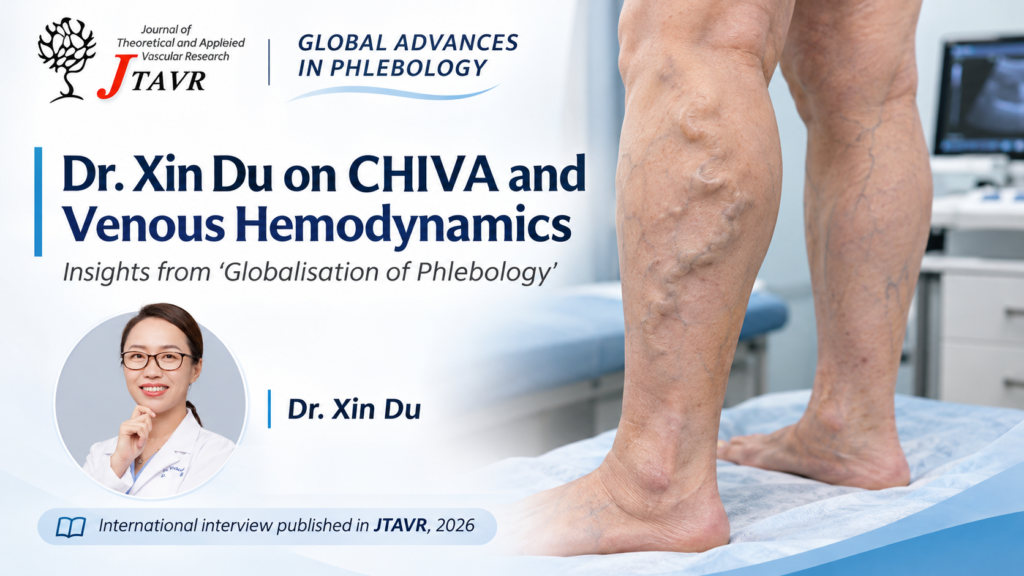
Exploring vein-preserving strategies, individualized treatment, and the evolving role of Chinese clinical experience in international phlebology.
The treatment of varicose veins has undergone substantial technological development over recent decades. From conventional stripping to endovenous thermal ablation, advances in procedural techniques have expanded the options available to clinicians. Yet an important question remains: should successful venous treatment be defined primarily by eliminating abnormal veins, or by correcting pathological blood flow while preserving functional venous structures?
This question lies at the center of an international interview with Dr. Xin Du, Attending Physician and Medical Director of Beijing Dr. Smile Vein Center, published in the Journal of Theoretical and Applied Vascular Research (JTAVR) on April 30, 2026.
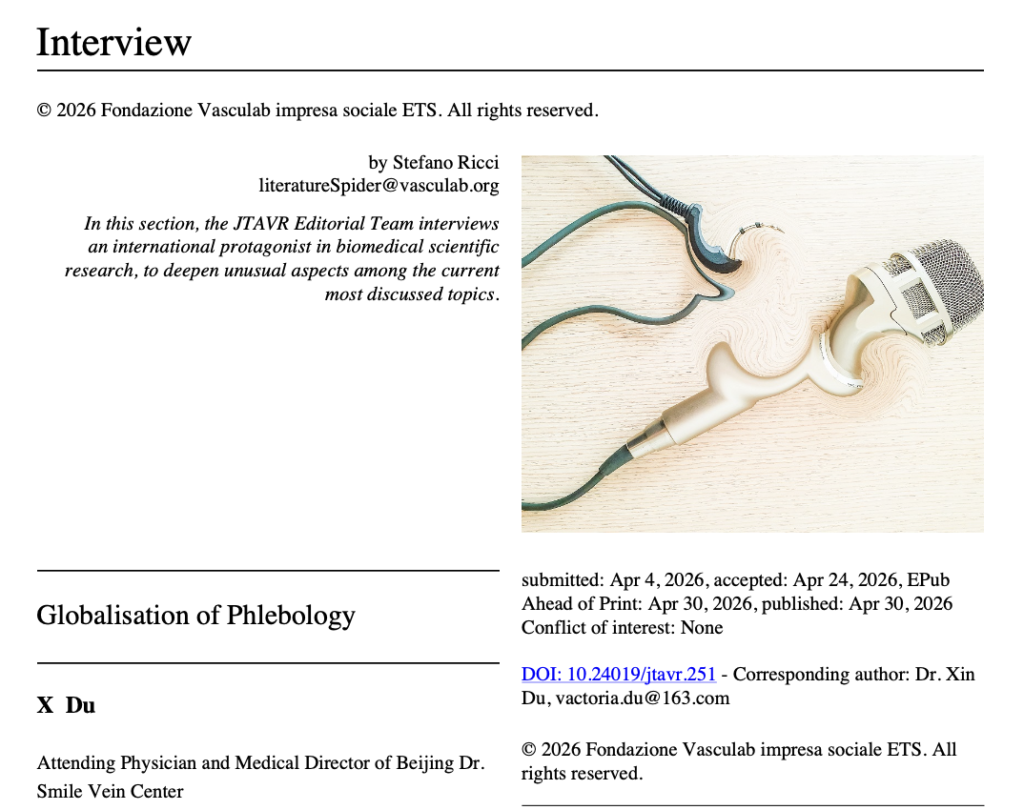
Conducted by Italian phlebology expert Prof. Stefano Ricci under the title “Globalisation of Phlebology,” the interview offers an extensive perspective on the development of hemodynamic approaches in China, the clinical application of CHIVA, and the challenges of translating alternative treatment philosophies into established medical practice.
Beyond its discussion of a particular technique, the interview raises broader questions about clinical reasoning, physician education, and the relationship between technological progress and physiological preservation.
From Anatomical Elimination to Hemodynamic Correction
For decades, conventional varicose vein treatment has largely focused on removing, closing, or ablating incompetent venous segments.
CHIVA (Conservative and Haemodynamic Cure of Venous Insufficiency in Ambulatory Surgery) approaches the problem differently. Rather than treating every refluxing vein as a structure requiring elimination, the strategy seeks to identify pathological hemodynamic circuits and selectively modify them while preserving useful venous pathways.
Dr. Du’s professional experience illustrates this conceptual transition.
Having initially practiced conventional stripping, foam sclerotherapy, and endovenous thermal ablation, she began systematically adopting CHIVA in 2017 following academic exchanges with European specialists, including Prof. Claude Franceschi.
The experience led her clinical team to place greater emphasis on understanding venous flow patterns, functional anatomy, and the physiological consequences of intervention.
This distinction is relevant to contemporary phlebology because it shifts attention from the technical ability to close a vein toward the clinical reasoning required to determine whether closure is necessary.
Ultrasound as a Tool for Clinical Reasoning
One of the most significant themes in the interview is the role of duplex ultrasound in hemodynamic assessment.
Dr. Du argues that ultrasound should not be viewed simply as a diagnostic examination performed before treatment. Within a hemodynamic strategy, it becomes an essential instrument for understanding venous circulation and designing individualized interventions.
In her clinical group, physicians are expected to personally perform venous flow assessment and mapping rather than rely exclusively on conventional imaging reports.
This requirement reflects a broader educational challenge: implementing hemodynamic treatment involves more than acquiring a new surgical technique. It requires clinicians to develop the ability to interpret venous flow, distinguish pathological reflux from functional drainage, and connect ultrasound findings with treatment decisions.
Dr. Du also describes preliminary efforts to explore AI-assisted modules for standardizing ultrasound assessment workflows.
Although these developments remain exploratory, they raise an important possibility for future venous education: digital tools may eventually help improve consistency in hemodynamic assessment while leaving individualized clinical judgment in the hands of trained physicians.
Vein Preservation and the Challenge of Changing Clinical Practice
The interview also examines why vein-preserving approaches can encounter resistance, even when clinicians recognize the theoretical importance of maintaining vascular function.
Dr. Du describes how conventional treatment preferences, established training pathways, reimbursement structures, and familiarity with device-based procedures have influenced the adoption of CHIVA in China.
An important distinction emerges between the technical standardization of a procedure and the intellectual demands of a hemodynamic strategy.
Whereas many device-driven interventions follow relatively standardized procedural pathways, CHIVA requires detailed evaluation of the patient’s venous anatomy, reflux patterns, drainage circuits, and clinical expectations.
This complexity contributes to its learning curve and presents challenges for broader dissemination.
The interview also highlights the importance of defining the objectives of vein preservation.
Preserving the great saphenous vein is not solely about maintaining a potential conduit for future vascular reconstruction. From a hemodynamic perspective, the broader objective is to retain useful venous function and avoid unnecessary disruption of the venous network.
At the same time, Dr. Du acknowledges that CHIVA is not appropriate for every patient or anatomical configuration.
This recognition reinforces a fundamental principle of individualized care: treatment selection should reflect clinical suitability rather than adherence to a single procedural philosophy.
Clinical Experience, Outcomes, and the Need for Stronger Evidence
Among the most clinically relevant aspects of the interview is Dr. Du’s discussion of long-term outcomes and treatment refinement.
She reports that recurrence rates within her team’s clinical experience decreased from approximately 7% during the early period of CHIVA practice to around 4.5% following refinements in surgical strategy, with a mean follow-up of 76 months.
These figures provide insight into the team’s reported experience but should not be interpreted as definitive comparative evidence of superiority over other treatment methods.
Importantly, Dr. Du acknowledges that much of the group’s accumulated clinical experience has not yet been systematically presented in the international scientific literature.
She describes ongoing efforts to prepare English-language manuscripts and organize clinical findings for broader academic evaluation.
This distinction between clinical experience and published evidence is particularly important.
While observations from experienced clinical teams can generate valuable hypotheses and inform future investigation, robust assessment requires clearly defined study populations, standardized outcome measures, transparent methodology, and appropriate long-term follow-up.
The interview therefore highlights an opportunity for international research collaboration: translating substantial clinical experience into reproducible scientific evidence that can be critically evaluated by the wider phlebology community.
Education and the International Development of CHIVA
The dissemination of hemodynamic treatment depends not only on procedural experience but also on structured education and international cooperation.
Dr. Du recounts the development of CHIVA educational activities in China, including a national academic conference on venous hemodynamics organized in 2019.
She also discusses the collaboration initiated with Inteleos in 2021 to establish the Global CHIVA Program, officially launched in 2022 with support from an international group of experts.
These initiatives reflect efforts to make specialized hemodynamic knowledge more accessible to physicians across different healthcare environments.
The original interview also acknowledges collaboration with Asian Venous Academy (AVA), an independent academic institution established in Hong Kong in 2018, in supporting educational exchange and professional connections between Asian and international practitioners.
Such activities demonstrate that the globalization of phlebology is not simply the geographical expansion of established medical techniques.
It also involves the exchange of clinical perspectives, educational frameworks, and scientific questions between specialists working in different medical systems.
A Broader Perspective on the Future of Phlebology
The significance of Dr. Du’s interview extends beyond the development of CHIVA in China.
It reflects an ongoing discussion within venous medicine about how treatment decisions should integrate anatomy, physiology, clinical evidence, technical innovation, and patient-centered outcomes.
Vein-preserving approaches offer one perspective within this broader discussion, while conventional and endovenous techniques remain important options according to individual clinical circumstances.
Rather than establishing one treatment philosophy as universally preferable, the interview encourages closer examination of how different strategies are selected, evaluated, and taught.
For the international phlebology community, the contribution of clinical experiences from Asia offers additional opportunities for comparative research, professional education, and scientific collaboration.
Ultimately, the continuing evolution of venous medicine will depend not only on developing new technologies, but also on improving the quality of clinical reasoning, strengthening the evidence base, and maintaining meaningful dialogue across different approaches to venous disease.
Original Publication
Title: Globalisation of Phlebology
Interviewee: Dr. Xin Du
Interviewer: Prof. Stefano Ricci
Journal: Journal of Theoretical and Applied Vascular Research (JTAVR)
Publication Date: April 30, 2026
Volume: 11, Issue 1, pp. 55–63
DOI: https://doi.org/10.24019/jtavr.251
This article is an independent academic commentary based on the published interview. Clinical observations and outcomes discussed are attributed to the interviewee and should not be interpreted as independently verified comparative findings.