Beyond Innovation: HKL Vascular Conference 2026 Turns Attention to the Standards Behind Everyday Vascular Care
KUALA LUMPUR — As vascular medicine becomes increasingly defined by new devices, minimally invasive procedures and rapidly evolving evidence, an equally important question is emerging across the specialty: how should these advances be translated into consistent standards of everyday clinical care?
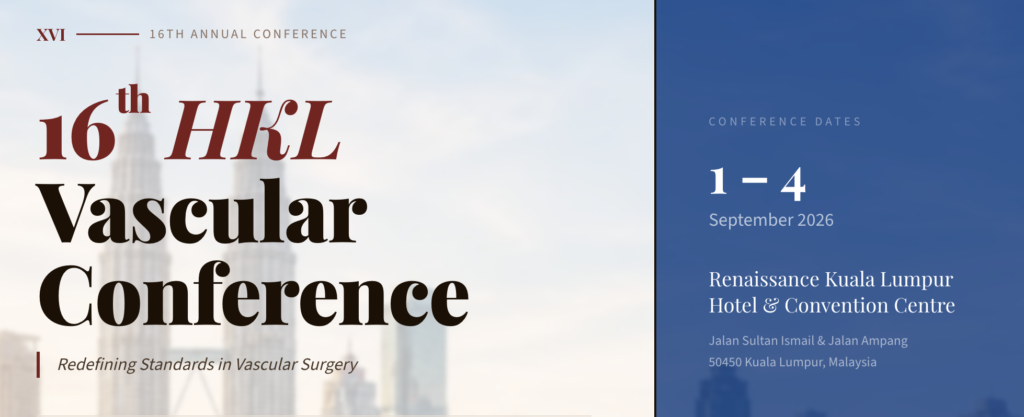
That question will sit at the heart of the 16th HKL Vascular Conference, taking place from 1–4 September 2026 in Kuala Lumpur, Malaysia.
Organised by the Vascular Unit, Department of General Surgery at Hospital Kuala Lumpur, this year’s meeting carries the theme “Redefining Standards in Vascular Surgery.” The programme extends across pre-congress workshops on 1 September, the main scientific congress on 2–3 September at the Renaissance Kuala Lumpur Hotel & Convention Centre, and a post-congress masterclass at Hospital Kuala Lumpur on 4 September.
Yet the significance of the theme goes beyond adopting newer technology.
Across arterial disease, venous disease, vascular access and wound management, the programme repeatedly returns to a more practical issue: what should clinicians regard as appropriate, reproducible and evidence-based care in 2026?
When Evidence Becomes a Clinical Pathway
One of the clearest expressions of this approach appears in the session “Evidence and Guidelines — Setting New Standards.”
Rather than focusing on a single disease territory, the programme brings together several areas in which clinical practice continues to evolve: carotid revascularisation, chronic venous ulcer management, antithrombotic therapy, central venous disease and acute limb ischaemia.
The questions are deliberately practical.
How should current evidence influence carotid revascularisation? How can chronic venous ulcer care become more standardised? What is the appropriate antithrombotic strategy for patients with vascular disease today? And when acute limb ischaemia presents, how should clinicians choose among open, endovascular and hybrid treatment?
These subjects highlight an important challenge in contemporary vascular care. Evidence may establish what is possible or statistically beneficial, but translating that evidence into a clinical pathway requires consideration of anatomy, patient characteristics, available expertise, institutional resources and long-term outcomes.
The HKL programme therefore places considerable emphasis not simply on individual procedures, but on the decisions surrounding them.
Venous Disease Moves Into the Standards Conversation
Venous disease also has a visible place within this wider discussion.
The scientific programme includes dedicated presentations on chronic venous ulcers and central venous disease, while an industry-supported symposium will examine DVT management with venous stenting following thrombectomy.
The inclusion of these subjects is significant because venous care increasingly extends beyond isolated procedural intervention.
For patients with chronic venous ulceration, for example, successful management may depend on far more than treating venous reflux or obstruction alone. Wound assessment, compression, rehabilitation, primary-care follow-up and the identification of contributing vascular disease can all influence healing and recurrence.
This broader approach is reflected in the conference’s allied health programme, where chronic venous ulcer management is discussed alongside vascular wound assessment, negative-pressure wound therapy, rehabilitation, nutrition and compression therapy.
The result is a view of venous disease that is increasingly integrated into the wider continuum of vascular and wound care.
Dialysis Access as a Long-Term Vascular Strategy
Another major component of the programme is vascular access.
A dedicated session, “Vascular Access — Optimising Dialysis Access Outcomes,” examines the entire pathway rather than concentrating only on the technical creation of an arteriovenous fistula.
Topics range from preoperative mapping and patient selection to the evolving involvement of nephrologists in AVF management, endovascular treatment of dysfunctional fistulas, paediatric dialysis access and percutaneous thrombectomy.
This reflects a broader change in thinking around dialysis access.
A functioning access is not simply the result of a successful operation. Its long-term performance depends on appropriate planning, surveillance, maintenance and timely intervention when dysfunction occurs.
The discussion therefore naturally crosses traditional specialty boundaries, involving vascular surgeons, nephrologists, interventional specialists and the wider dialysis team.
In this context, “optimising outcomes” becomes less about any single technique and more about managing the life cycle of a patient’s vascular access.
Wound Care Becomes Part of Vascular Care
The programme’s attention to wound management further illustrates this multidisciplinary direction.
A full pre-congress wound care workshop will address wound assessment, compression therapy, negative-pressure wound therapy, non-invasive vascular assessment, ultrasonic-assisted wound debridement and amputee rehabilitation.
During the main congress, the allied health track continues the discussion through sessions on diabetic foot ulcer management, arterial ulcers, chronic venous ulcers, rehabilitation, physiotherapy, nutrition and compression therapy.
For vascular teams, these topics are increasingly inseparable from questions of limb preservation.
Restoring arterial inflow or correcting venous pathology may be essential, but vascular intervention alone does not guarantee wound healing. Infection control, tissue management, pressure reduction, mobility, nutrition, compression and rehabilitation all contribute to the final clinical outcome.
The structure of the HKL programme reflects this reality by placing procedural vascular treatment and longitudinal wound care within the same educational framework.
Redefining a Standard Means More Than Introducing a New Device
Modern vascular meetings inevitably feature new technologies, and the 2026 HKL programme is no exception.
But the more distinctive message running through this year’s agenda is that technological capability does not automatically become a clinical standard.
A new intervention must still be evaluated against patient selection, established alternatives, procedural risk, durability, clinical evidence and the realities of local healthcare delivery.
That principle applies whether the discussion concerns peripheral intervention, dialysis access, carotid disease, venous stenting, wound management or complex aortic treatment.
In some cases, redefining a standard may mean adopting a new technology.
In others, it may mean improving patient selection, creating a more consistent treatment pathway, strengthening multidisciplinary cooperation or recognising that an established treatment remains the better option.
A Broader Definition of Vascular Excellence
Now in its 16th edition, the HKL Vascular Conference has developed as an established educational meeting for vascular specialists and allied healthcare professionals in Malaysia and the wider Southeast Asian region. The organisers describe the meeting as spanning vascular surgery, interventional practice, vascular medicine and allied health, with a programme covering both advanced intervention and practical clinical care.
The 2026 programme suggests that the next phase of vascular care may be defined as much by integration as by innovation.
Good vascular outcomes increasingly depend on connecting diagnosis with intervention, intervention with follow-up, revascularisation with wound healing, thrombectomy with venous reconstruction, and procedural expertise with multidisciplinary care.
Seen from this perspective, “Redefining Standards in Vascular Surgery” is not simply a conference theme.
It describes an ongoing shift within the specialty — from asking what can be done to determining what should routinely be done, for which patient, and within what system of care.
Conference at a Glance
16th HKL Vascular Conference 2026
Theme: Redefining Standards in Vascular Surgery
Dates: 1–4 September 2026
Pre-Congress Workshops: 1 September
Main Congress: 2–3 September
Post-Congress Masterclass: 4 September
Main Venue: Renaissance Kuala Lumpur Hotel & Convention Centre, Kuala Lumpur, Malaysia
Organiser: Vascular Unit, Department of General Surgery, Hospital Kuala Lumpur
Programme details are subject to change. Readers are advised to refer to the official conference website for the latest information.